Blog/Bitunix Fee Rebate: How It Works at Every Volume
General
Bitunix Fee Rebate: How It Works at Every Volume
Bitunix fee rebate: how it works, what the 35% rebate saves at different trading volumes, and how it combines with Crodl's free-access rule.
The Bitunix fee rebate pays back 35% of the trading fees you pay on a Bitunix account opened through the Crodl partnership. The rebate lasts for the life of the account. If you also trade $100k of volume in every rolling 30-day window, you use the platform for free.
Search "bitunix fee rebate how it works" and most results are referral-code pages quoting percentages that don't agree with each other. This article works through the maths instead, so you can see what 35% is worth at your own volume.
All fee figures below come from Bitunix's published schedule. The dollar amounts are simple arithmetic you can check yourself.
How does the Bitunix fee rebate work?
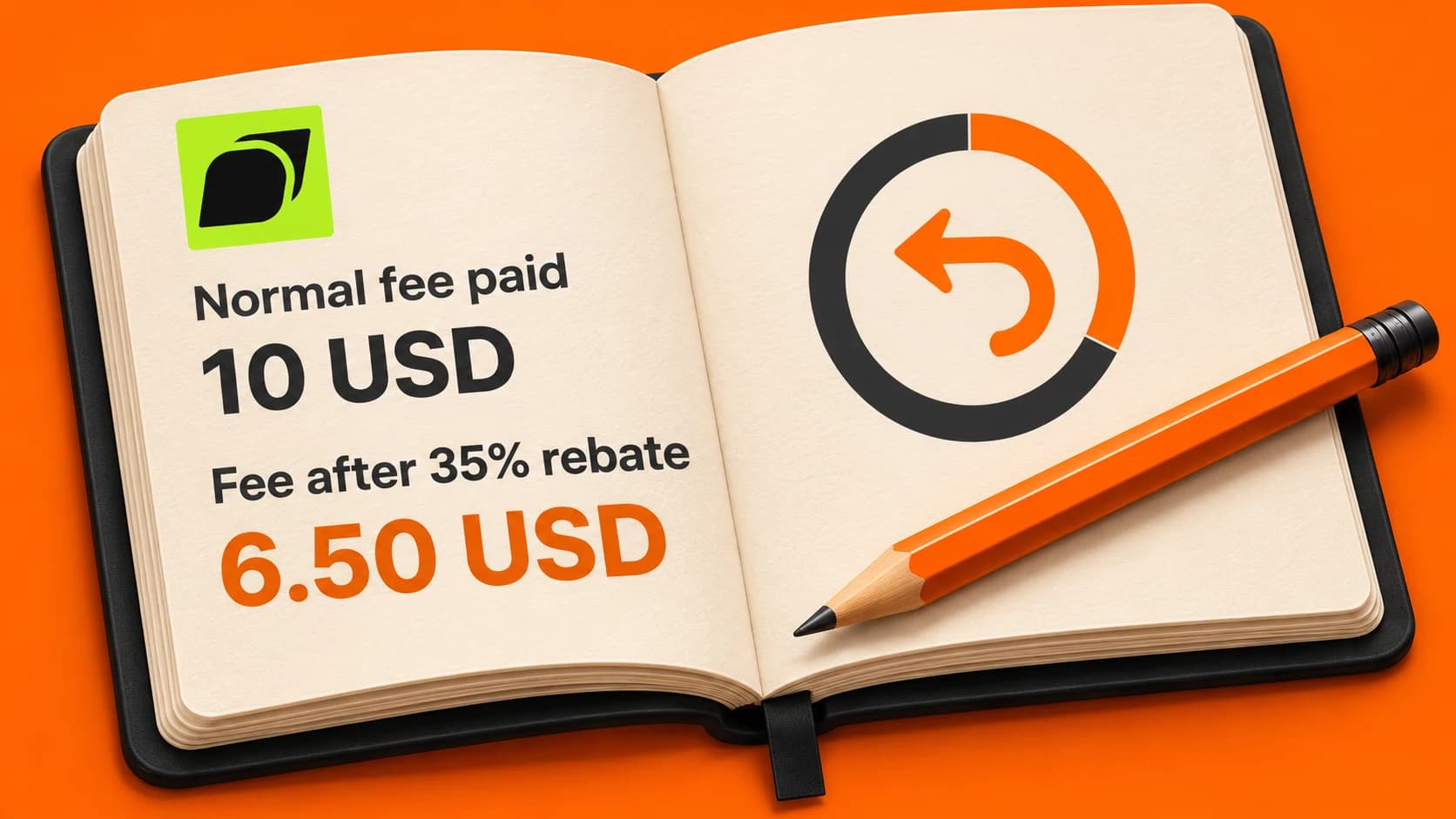
The Bitunix fee rebate returns a fixed percentage of the trading fees you have already paid. Bitunix charges its normal maker or taker fee on every fill. Then 35% of that fee goes back to you. Your listed fee rate stays the same.
Your net cost falls by about a third.
The rebate comes from the referral relationship that is attached to your account when you sign up. The exchange shares part of its fee revenue with the partner that referred you, and that partner passes 35% back to you. Because of this, the rebate is tied to the account itself. It doesn't depend on any particular trade or strategy.
It doesn't change your VIP tier. Your tier still depends on 30-day volume or balance, exactly as it would without the rebate.
It doesn't apply to funding payments. On perps, funding passes between longs and shorts. It isn't a trading fee, so the rebate has nothing to return on it.
It doesn't reduce your losses. The rebate makes each trade cheaper to execute. It doesn't make a losing system profitable.
Bitunix futures fees: the rates the rebate is calculated on
Bitunix futures fees start at 0.02% maker and 0.06% taker at VIP 0. Each fee is charged on the notional value of the fill. The rebate is always 35% of whatever you actually pay, so your VIP tier sets how large the starting fee is.
One detail matters here. Bitunix lets you qualify for a tier through spot volume, futures volume or account balance, and you only need to meet one of them. An account holding 300 USDT or more therefore sits at VIP 1 with a 0.05% taker fee, even if it trades very little. Check which tier your account shows before you use the numbers below.
Effective fee rates after a 35% rebate
Multiply any rate by 0.65 to get what you really pay after the rebate:
Tier
Effective maker
Effective taker
VIP 0
0.0130%
0.0390%
VIP 1
0.0130%
0.0325%
VIP 2
0.0104%
0.0325%
VIP 3
0.0091%
0.0260%
Compare those with the published tiers. A VIP 1 account with the rebate pays an effective 0.0325% taker fee. That is lower than VIP 5's listed 0.035%, and VIP 5 needs $50M of monthly futures volume. Without the rebate, most retail traders will never get to rates that low.
The 35% rebate at different monthly volumes
At VIP 0 with market orders only, the 35% rebate returns $21 for every $100k of volume. At $1M it returns $175, because the taker fee drops to 0.05%. The rebate grows in line with your volume, while each step up in VIP tier makes it slightly smaller per dollar traded.
The table assumes every fill is a taker fill and that your tier comes from volume alone:
30-day futures volume
Tier
Taker rate
Fees paid
35% rebate
Net fees
$100,000
VIP 0
0.060%
$60
$21
$39
$250,000
VIP 0
0.060%
$150
$52.50
$97.50
$500,000
VIP 0
0.060%
$300
$105
$195
$1,000,000
VIP 1
0.050%
$500
$175
$325
$5,000,000
VIP 2
0.050%
$2,500
$875
$1,625
$10,000,000
VIP 3
0.040%
$4,000
$1,400
$2,600
If your balance already puts you at VIP 1, use 0.05% from the first dollar. That works out to $17.50 back per $100k instead of $21.
Order type matters more than you'd expect
Your maker/taker mix can change the result by a factor of three. Here is $500k of volume at VIP 0 with different mixes:
Order mix
Blended rate
Fees paid
35% rebate
Net fees
100% taker
0.060%
$300
$105
$195
70% taker / 30% maker
0.048%
$240
$84
$156
50% taker / 50% maker
0.040%
$200
$70
$130
100% maker
0.020%
$100
$35
$65
Most webhook strategies enter with market orders, and stop-losses fill as taker orders, so automated traders usually sit near the top two rows. The rebate does the most where fees are highest. Taker-heavy systems therefore gain the most from it, measured in dollars.
Why leverage makes this matter
Fees are charged on notional value, not on your margin. At 10x leverage, a taker round trip at VIP 0 costs 0.12% of notional, which is 1.2% of the margin you put up. After the rebate, the same round trip costs 0.078% of notional, or 0.78% of margin. If your strategy aims for small wins many times a month, that difference shows up in your PnL.
When does the rebate make the platform free?
The platform becomes free once you trade $100k of volume in your first 30 days and then $100k in every rolling 30-day window after that. You get free access on top of the 35% rebate. Below that threshold, the rebate partly offsets a paid plan. At any volume, it reduces your fees.
That means two separate mechanisms are at work, and they're easy to mix up:
The volume rule decides whether you pay for the platform. It's simply $100k or more in a rolling 30-day window, with no further conditions.
The rebate is cash back on exchange fees. It applies whether or not you meet the volume rule, because it's tied to the Bitunix account.
At the $100k line, the rebate is only $7 to $21 depending on your order mix. On its own, that doesn't cover most software subscriptions. The volume rule is what makes the platform free at lower volumes. The rebate cash only grows into real money once you trade well into six figures a month.
The break-even formula below $100k
If you trade under $100k and pay for a plan, the rebate covers part of it. To find the volume where the rebate alone would cover a given monthly cost:
At VIP 0 with taker fills only, every $10k of volume returns $2.10. At VIP 1 it returns $1.75. If you only use maker orders, it returns $0.70.
Put in the current plan price from the site and you'll see that the rebate alone rarely covers it below $100k. That's the reason the volume rule exists.
What $100k of volume looks like in practice
Each fill counts as volume, so one round trip (an open and a close) adds roughly twice the position's notional value. A few examples:
$1,000 margin at 5x gives a $5,000 position, so about $10k of volume per round trip. Ten round trips in 30 days reaches $100k.
$2,000 margin at 10x gives a $20,000 position, so about $40k per round trip. Three round trips gets you there.
A 1x swing trader on the 4H holding $3,000 positions might do $30k to $50k a month. That trader won't reach the threshold without changing how they trade.
Scalpers and intraday systems on the 5m or 15m usually reach $100k within the first week. Swing systems with low leverage often don't reach it at all.
Don't manufacture volume to qualify
Don't add trades just to reach $100k. Trading $100k at VIP 0 with taker fills costs $60 in fees, or $39 after the rebate. Add to that whatever edge you give up by taking trades your system wouldn't normally take. If the plan costs less than that, paying for it is the cheaper choice.
Before you raise your trade frequency, backtest the change. More signals from a looser filter is a different strategy, and it may have worse expectancy. The free tier is a reason to choose where you route trades you would take anyway. It isn't a reason to change your system.
Who the 35% rebate suits, and who it doesn't
The rebate deal suits active derivatives traders who already do six figures or more of monthly perp volume and would otherwise pay full taker fees. It suits low-frequency traders much less. Traders who already have a better rebate or a higher VIP tier elsewhere will gain little from it.
Good fit:
Intraday or scalping systems running through TradingView webhooks, where most fills are taker fills
Traders already on Bitunix through an account with no referral attached, who are willing to open a fresh account
Multi-exchange traders who want to move their highest-turnover strategy to the venue with the lowest effective fees
Anyone paying for an automation tool who already trades $100k a month
Poor fit:
Low-leverage swing traders well below $100k a month. The rebate is worth only a few dollars to them.
Traders at VIP 5 or above elsewhere who have negotiated their own rates
Anyone who would have to change their strategy to reach the threshold
If you run strategies on several venues, compare the effective fee on each one, not just the listed rate. The cross-exchange analytics dashboard tracks fees per exchange, so you can see the actual cost of each venue instead of estimating it.
Setting up the rebate on a new Bitunix account
Setup takes four steps. The one that matters is opening the Bitunix account through the partner link. The referral is attached at signup and normally can't be added to an existing account later, so open the account through the link first and then trade.
Open a new Bitunix account through the partner link. Finish verification on Bitunix.
Create a Bitunix API key with trade permissions only and no withdrawal rights. Connect it to the platform. All connections go through the API only.
Trade as you normally would. Use the terminal for manual orders, or route TradingView alerts through Trading Triggers. Every fill counts toward both the rebate and the rolling $100k window.
Payout specifics can change, so check the current details in the Discord. Dewald answers partnership questions there himself. Before you route live size, test your symbol mapping and sizing rules on a small position.
Frequently asked questions
Can I get the 35% rebate on an existing Bitunix account?
Usually not. Exchanges attach a referral relationship when the account is created. An account opened without the partner link generally can't be moved under it later.
Most traders open a new Bitunix account through the partner link and point their automation at it. If your situation is unusual, ask in the Discord before you open anything, because exchanges handle sub-accounts and migrations differently.
Does the rebate change when I move up a VIP tier?
The percentage stays at 35%, but the dollar amount per trade falls as your tier improves, because you're paying a smaller fee to begin with. At VIP 0 the rebate is worth $2.10 per $10k of taker volume. At VIP 3 it's $1.40. Higher tiers still cost less overall: the rebate applies to whatever rate you actually pay.
What happens if I drop below $100k in a 30-day window?
Free platform access depends on the rolling volume rule, so a quiet month below $100k means free access no longer applies for that window. The 35% rebate is separate and lasts for the life of the account, so you keep receiving it on whatever volume you do trade. Your free access comes back once you're above the threshold again.
Is a 35% rebate better than a lower VIP fee rate?
For most retail traders, it is. With the rebate, VIP 1 pays an effective 0.0325% taker fee. That beats the 0.035% listed taker fee at VIP 5, which requires $50M of monthly futures volume. Only traders who already qualify for the top tiers, or who have negotiated custom rates, will find that their tier beats the rebate.
Does the rebate apply to funding fees?
No. Funding payments on perpetual futures pass between longs and shorts, and Bitunix doesn't collect them as a trading fee. Only maker and taker trading fees are rebated. If you hold leveraged positions for days through high funding, that cost stays the same whatever rebate you have.
The bottom line on the 35% rebate
The rebate cuts your Bitunix trading fees by 35% for the life of the account. With the rebate, VIP 1 taker fees come in below VIP 5's listed rate. The free platform access comes from a separate rule: $100k of volume in every rolling 30-day window.
At $100k a month, the rebate returns $7 to $21. At $1M it's $70 to $175. At $10M it can pass $1,000.
Next, check your actual 30-day futures volume and maker/taker split on your current exchange. Put those into the tables above. If you trade more than $100k a month, open your account and set up the Bitunix rebate before your next strategy goes live.
Information disclaimer: This article draws on official documentation and other sources available at the time of writing. We aim to keep it accurate, but information may be incomplete or become outdated. Bitunix fees, VIP tiers, rebate eligibility, payout arrangements and partnership terms, as well as Crodl's free-access requirements, can change without notice and may vary by account or region.
Always double-check the latest details with Bitunix and Crodl before signing up, connecting an account or placing trades. Fee and rebate examples are illustrative and may differ from your actual costs.
This content is for general information only and is not financial or investment advice. Trading involves risk, and a fee rebate does not guarantee profits or prevent losses.
Referral disclosure: The Bitunix signup link in this article is a referral link. Crodl may earn a commission from Bitunix when you sign up through it and trade, at no extra cost to you.
Share this article
Ready to automate your trading?
Connect your exchange, set up automations, and start trading smarter — all from one platform.