Trender
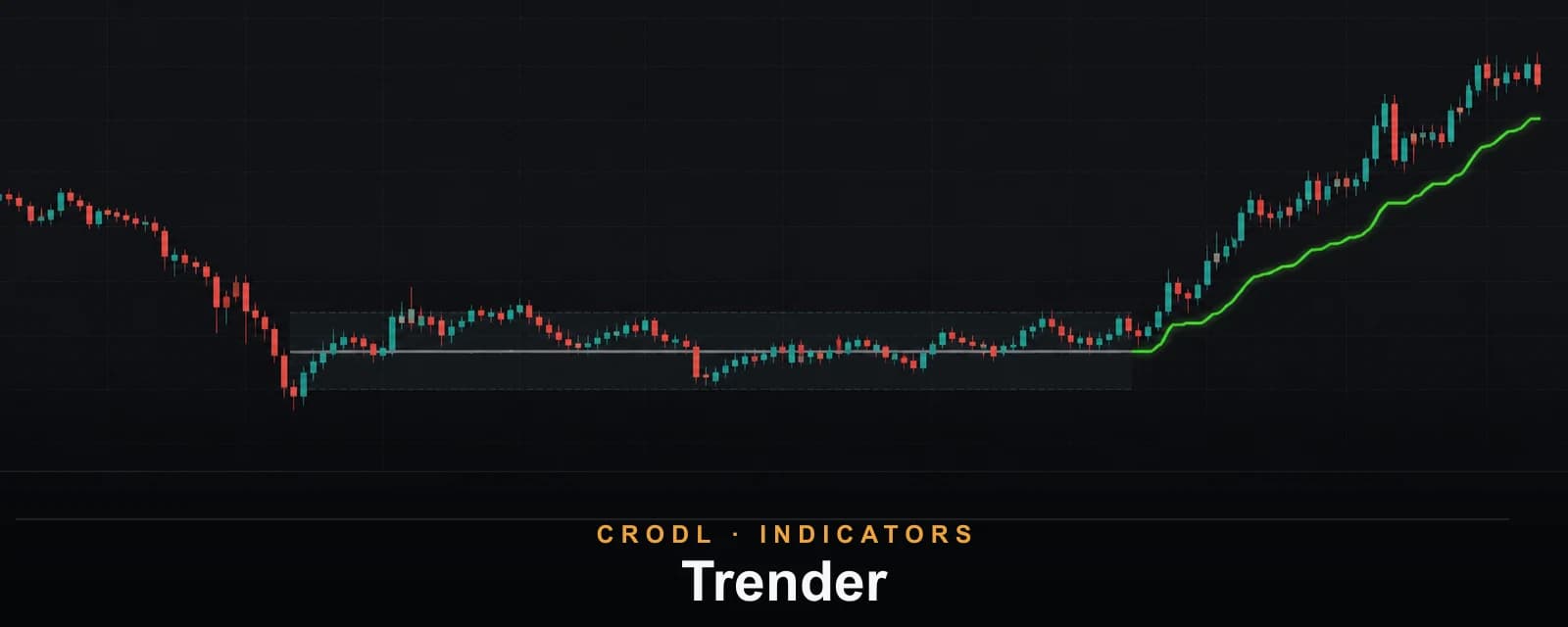
A Kalman-filtered trend rail that holds flat inside noise, then commits to a controlled rising or falling leg when the market actually changes state.
Most trend lines have one failure mode: they follow everything. If price moves, the average moves; when price chops, the line wiggles and changes direction until the chart looks more certain than the market really is.
Trender is built around a different visual contract. Inside an adaptive noise band, its rail can remain perfectly flat. Once evidence of a genuine state change accumulates, it commits to a rising or falling leg and advances at a controlled speed. The result is less like a moving average and more like a ratchet: hold, release, pursue, hold again.
Crodl's Rune preset is a port of Trading-IQ's MPL-2.0 “Trender [IQ]” concept, adapted to the terminal's renderer and alert system.
Reading the rail
- Gray means holding. Price is moving inside the estimated noise corridor and the rail refuses to invent a trend.
- Green means a committed rising leg.
- Violet means a committed falling leg.
- The faint Hold Band appears around flat segments and eases shut once a leg begins.
- Optional triangles mark rising/falling commits; optional diamonds mark a return to hold.
The rail is deliberately monotone inside a leg. A rising segment cannot tick down bar by bar; a falling segment cannot tick up. Reversal requires more than a tiny counter-move.
The filter underneath
Trender uses a local-linear-trend Kalman model. In plain language, it estimates both the market's level and slope, predicts the next observation, then updates those estimates as each candle arrives. Its uncertainty becomes the adaptive hold-band width.
Two protections keep outliers from taking over:
- Huber weighting reduces the influence of innovations beyond 2.5 estimated deviations. A violent wick still informs the filter, but it cannot drag the entire state with it.
- A CUSUM change-point test accumulates standardized surprises. When repeated upside or downside deviations cross the threshold, the model recognizes that the old state may no longer describe the market and temporarily adapts faster.
With Use Log Geometry enabled by default, calculations run in log price. That makes the band percentage-aware: a $100 move has a different meaning at $1,000 than at $100,000.
From estimate to rail
The Kalman center is not drawn directly. A second state machine decides whether the visible rail should hold, rise, or fall.
A flat rail starts a leg when the center breaks its adaptive band, or when slope conviction is already strong enough to justify an earlier release. Once running, the rail moves toward the center without overshooting it. An opposite leg requires both a band break and a matching CUSUM change-point, which is why small pullbacks do not constantly flip the color.
The rail returns to gray when it catches the center within a small freeze tolerance and trend conviction has faded.
Inputs that change its personality
Speed
Glacier, Slow, Balanced, Fast, and Scalp jointly control the dead-band width and pursuit rate. Glacier demands broad structural movement; Scalp follows much more tightly. Balanced is the default.
Pursuit
- Steady uses a constant pursuit rate.
- Eased scales the speed with trend conviction.
- Snap commits hardest once a leg is active.
Pursuit changes the shape of an accepted leg, not the evidence used to identify the underlying trend.
The remaining inputs toggle log geometry, the hold band, flip markers, hold markers, and the three state colors. Plot widths and opacity remain editable from the Style tab.
How traders use it
Trender is most useful as a regime and trade-management layer. A flat rail tells a trend follower to stop treating every breakout wick as a new campaign. A fresh green commit after an extended hold can license long-only setups; a return to hold warns that the directional edge has decayed.
For entries, pair it with location. A green commit that occurs as price clears an S/R resistance zone has a structural reason behind it. A green rail chasing price directly into higher-timeframe resistance is much less attractive.
Because the rail intentionally lags noisy movement, it is also a natural trailing reference: staying on the correct side of a committed rail keeps the process mechanical without demanding an exit at every candle-color change.
Frequently Asked Questions
Is Trender a moving average?
No. It estimates a filtered level and slope, then feeds them into a separate hold/leg state machine. A moving average continuously follows its input; Trender can remain exactly flat.
Why did price break the band without an immediate reversal?
A running leg reverses only when the opposite band break is confirmed by a change-point in the same direction. That extra condition is the whipsaw filter.
Are the markers signals?
They mark closed-bar state transitions and are available as alerts, but they are not complete trade setups. Direction still needs price location and risk definition.
Let the rail admit uncertainty
Add Trender from the Crodl indicator picker when you want a trend tool that is comfortable saying “holding” instead of repainting every noisy candle as a new direction.
This article is for educational purposes only and is not financial advice. Leveraged trading carries substantial risk of loss. Always do your own research and never risk more than you can afford to lose.

Ready to automate your trading?
Connect your exchange, set up automations, and start trading smarter — all from one platform.
Start Trading Free