
Candle Countdown: TD-Sequential-Style 9-Counts for Trend Exhaustion
How Crodl's Candle Countdown indicator counts TD-Sequential-style buy and sell setups from 1 to 9, flags perfected 9s, and helps you time exhaustion in trends.
Some of the most reliable turns in crypto happen not at a level, but after a count — a run of persistent one-directional closes that simply exhausts itself. That observation is the core of TD Sequential, the famous DeMark methodology whose "9" prints have marked an uncanny number of local tops and bottoms. The full methodology is sprawling; the part most traders actually use is the setup count.
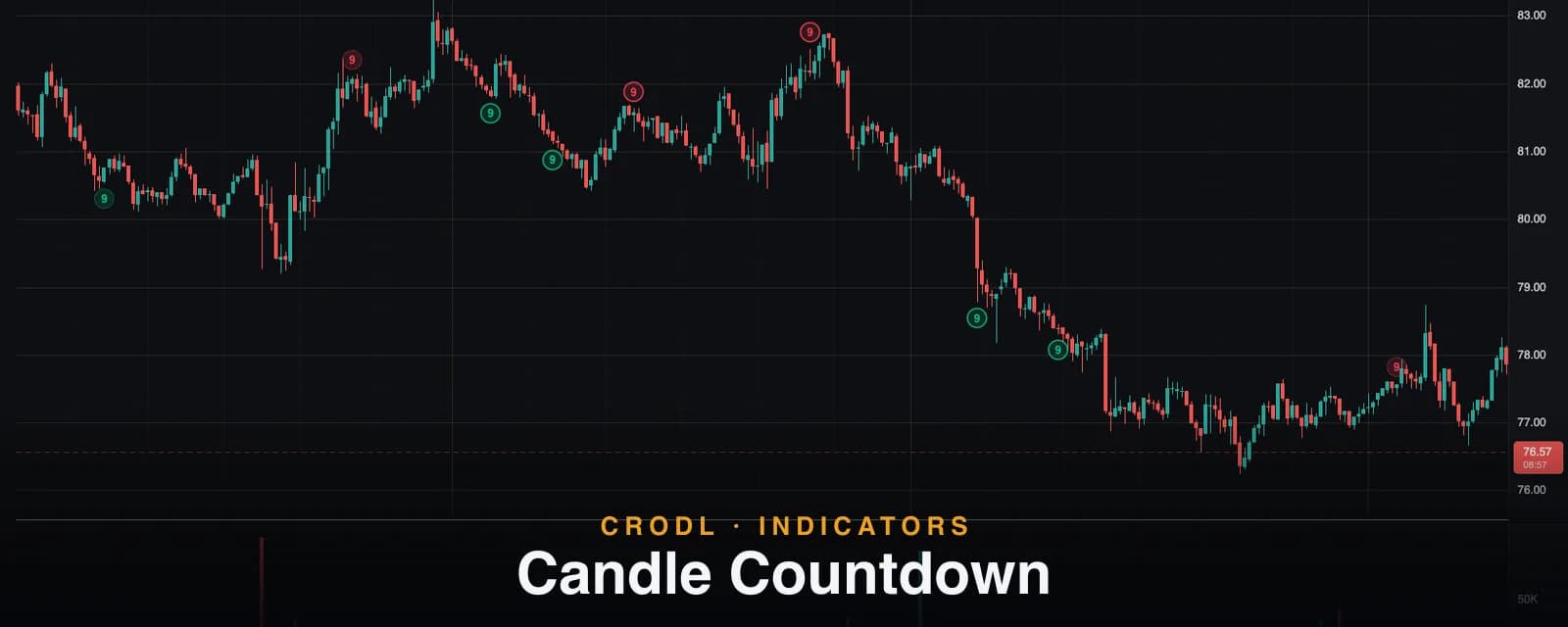
The Candle Countdown indicator on the Crodl terminal implements exactly that part, cleanly: the TD-Sequential-style setup phase, counting qualifying candles from 1 to 9 in both directions and flagging the completed 9s — including the perfected ones — right on your candles.
By default it stays quiet until a count matures, showing numbers only from 7 onward. When a 9 completes, it gets a circled badge you cannot miss. The result is a chart that whispers "this move is getting old" at exactly the moment FOMO is loudest.
What Candle Countdown shows
The indicator paints small numerals on the candles. Sell setup counts (red by default) appear above bar highs — they track persistent upside pressure, so a sell 9 marks potential upside exhaustion. Buy setup counts (green) appear below bar lows and mirror the logic for downside exhaustion.
A completed 9 always draws, emphasized in a filled circular badge. If the 9 is perfected — a stricter classical condition described below — the badge gets a brighter ring (toggleable via Highlight perfected 9). When you zoom far out, the per-bar numerals cull themselves to keep the chart readable: below roughly 6 pixels per bar only the 9-badges survive, and at extreme zoom-out the study hides entirely rather than smearing into noise.
How it works on the Crodl terminal
The counting rules are the well-known TD Sequential setup phase:
- Buy setup: each bar that closes below the close from 4 bars earlier extends the count — 1, 2, 3… up to 9. A 9 completes the setup: nine straight closes weaker than their 4-bar-ago reference is a statistically stretched decline.
- Sell setup: the mirror — consecutive bars closing above the close from 4 bars earlier.
- Strict comparisons: a close exactly equal to its reference satisfies neither side and resets both counts. Any bar that fails a side's condition resets that side's count.
- Perfection: a buy 9 is perfected when the low of bar 8 or bar 9 undercuts the lows of bars 6 and 7 — the count ended with a genuine push into new lows rather than a drift. Sell setups mirror with highs.
- After the 9: the count resets, so an unbroken run prints 9, 1, 2, … — matching how the classic sequence continues on persistent trends.
One honest implementation note: classic TD Sequential gates a new setup behind a "price flip" (a specific reversal bar before counting begins). This implementation uses the common simplified form and counts on the raw close-vs-close[4] condition directly. In practice the counts land in the same places on sustained moves; purists should know the flip gate is not applied.
All of the indicator's settings are display-only — colors, sizes, and visibility thresholds never change the counts themselves, so what you see is always the same arithmetic.
| Stage | What you see (defaults) | What it means |
|---|---|---|
| Counts 1–6 | Hidden | Setup building — too early to act on |
| Counts 7–8 | Numerals appear | Move is stretched; exhaustion watch begins |
| 9 | Circled badge | Setup complete — classic reaction zone |
| Perfected 9 | Badge with bright ring | Count ended on a fresh extreme — the textbook form |
The settings that matter
- Show counts from — the first count worth displaying (default 7). The 9 always draws regardless.
- Show all counts (1–9) — reveal the full count progression, useful when learning the rhythm of the tool.
- Highlight perfected 9 — the brighter ring on perfected setups (on by default).
- Label size — numeral size from 8–14 px.
- Buy / Sell colors — green below lows and red above highs by default.
How traders use it
An anti-FOMO governor
The simplest use is defensive: a sell setup reading 8 after a vertical rally is a terrible place to open fresh longs. The count doesn't say "short it" — it says the move is old, and chasing here means buying the ninth consecutive push. Many traders use the 7–8–9 sequence purely to time exits and tighten stops on winners.
Exhaustion confluence at structure
A 9 printing into a meaningful level is far more interesting than a 9 in a vacuum. The high-conviction stack: a sell 9 arriving at a Visible S/R resistance zone while a bearish RSI divergence confirms fading momentum — three independent exhaustion arguments agreeing at one price.
Respecting the perfected flag
Perfection is the classical quality filter: a 9 whose final bars actually pressed into new extremes. Traders who take countertrend entries off 9s often require the perfected ring, treating unperfected 9s as watch-only.
Timeframe discipline
Counts print on every timeframe, but their meaning scales with it. A 9 on the 5-minute chart marks a scalp-sized reaction; a daily 9 has historically marked swing turns. Whatever the timeframe, the count describes that timeframe's rhythm only.
Honest limitations
This is the setup phase only — the full TD Sequential 13-bar countdown that follows a completed setup is deliberately out of scope. A 9 marks conditions for a reaction, not a guaranteed reversal: strong trends routinely absorb a 9, print the 9-1-2 continuation, and keep going. And on the live bar, the current count can change until the candle closes — close versus close[4] isn't final until the close is — so treat an in-progress 8 or 9 as provisional until the bar completes.
Frequently Asked Questions
Is this the full TD Sequential system?
No, and deliberately so. It implements the setup count (1–9) with perfection detection — the part of the methodology most traders actually reference. The 13-countdown phase, TDST levels, and the price-flip gate are not included.
Can the current bar's count change?
Yes — until the bar closes, its close-vs-close[4] comparison can flip, so the forming bar's numeral is provisional. All completed bars' counts are final and never repaint.
What makes a 9 "perfected"?
For a buy setup: the low of bar 8 or bar 9 must be below the lows of both bars 6 and 7 (sell setups mirror with highs). It confirms the count ended on a real push into new extremes — the classical requirement before acting on the setup.
Why do the numbers disappear when I zoom out?
Readability culling. Below about 6 px per bar only the 9-badges draw; below about 3 px per bar the study hides entirely. Zoom in and the counts return.
Count the exhaustion before you chase it
Candle Countdown is available on every Crodl terminal chart — add it from the indicator picker and let the 9s find you, on any pair and timeframe, alongside live trading on six exchanges.
This article is for educational purposes only and is not financial advice. Leveraged trading carries substantial risk of loss. Always do your own research and never risk more than you can afford to lose.

Ready to automate your trading?
Connect your exchange, set up automations, and start trading smarter — all from one platform.
Start Trading Free