
Pivot Levels Strategy: The Breakout Arrows, Traded at 1:4
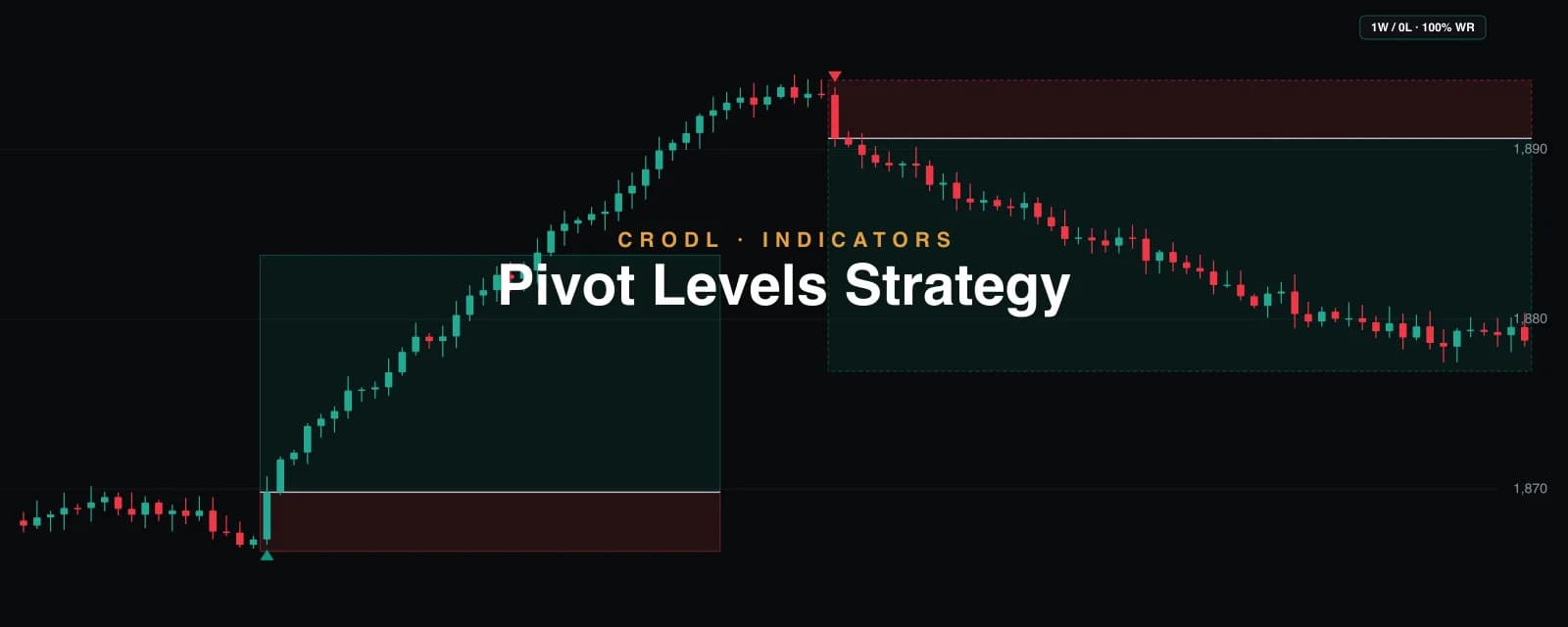
How Crodl's Pivot Levels Strategy trades the Pivot Levels breakout arrows one-per-side — entry at the arrow close, stop beyond the producing candle, target at 4R — drawing every trade's risk/reward zones with a win-rate scoreboard on the chart.
Everyone draws the same position tool: entry line, red box down to the stop, green box up to the target. Pivot Levels Strategy draws it for you — mechanically, on every qualifying Pivot Levels breakout arrow, with the outcome tracked and the running score pinned to the chart. It's the "what if I actually took every one of these" answer, live.
The rules (all of them)
- The signal: the Pivot Levels breakout arrow — a close through a managed support/resistance level — with alternation forced on: one arrow per side, up → down → up, repeats suppressed. The strategy literally imports the Pivot Levels engine, so what it trades is exactly what that indicator draws with the alternate-arrows toggle enabled.
- The entry: the signal candle's close. No waiting, no discretion — you trade the first one.
- The stop: beyond the producing candle — its low for longs, its high for shorts, plus a small ATR buffer (default 0.05×).
- The target:
Reward : risk× the stop distance — default 1:4. - One trade at a time: arrows that fire while a trade is open are skipped. The next trade may only start after the previous one resolved.
- Resolution: bar-by-bar, stop checked first — a bar that touches both counts as a loss. Conservative by construction.
Every trade draws its position-tool picture: green reward zone (entry → target), red risk zone (entry → stop), the entry line across both, from the entry bar to the bar that resolved it. A still-open trade extends to the last candle with dashed borders.
The scoreboard
The compact pill top-right — 6W / 10L · 38% WR — counts every resolved trade in the loaded history, on by default: a strategy without its scoreboard is a mood board. The arithmetic to hold it against: at 1:4 anything above 20% win rate is positive expectancy before fees; at 1:2 you need 33%; at 1:1 you need 50%.
Running the defaults on live tape: BTC/ETH/SOL across 5m–1h produced 1:4 win rates from 17% to 38% — several tapes comfortably above the 20% break-even line, because pivot-break arrows tend to fire early in a move, which is exactly what a high-R target wants. The same signals score 33–50% at 1:2 and 44–65% at 1:1. Different markets reward different ratios; the pill referees.
Settings
- Signal detection — the Pivot Levels chart-TF detector (Structure HH→LH default / Confirmed pivot / Slope turn), pivot length, and the break buffer.
- Risk — reward:risk (default 4), the ATR stop buffer beyond the producing candle, trades retained, the Half-way pullback entry toggle (off by default: instead of entering at the signal close, a limit rests at the signal candle's midpoint and fills only if price pulls back into it — the whole bracket shifts to the better entry with identical gap sizes and NEVER chases: a long's half entry can never sit above the standard entry (nor a short's below). If the midpoint isn't touched within the window — default 3 bars — the limit eases to the signal close and keeps waiting; a limit price never comes back to stays visibly pending instead of paying up. Which arrows get traded is decided exactly as in standard mode, so the half-entry trade list always matches the standard one bar-for-bar — it re-prices your trades, it never moves them), and two daily discipline gates (both off by default): Stop for the day once up — no new entries for the rest of a UTC day whose realized R is positive — and Stop after N losses in a day — the classic daily loss limit. Both skip entries only; they never touch an open trade, and the next UTC day always starts fresh.
- Style — zones, entry arrows, the W/L table, and the three colours.
Prefer the same trade engine on the Risk Pilot ATR-trail signals instead? That's Risk Pilot Strategy — identical rules, different trigger.
Alerts — server-side
Want the entries on your phone without keeping the chart open? Add Pivot Levels Strategy, then use its bell or Create Alert action. Crodl snapshots the strategy's current signal, bracket and daily-gate settings into the server alert automatically — there is no second preset to add or keep in sync. Choose Long entry or Short entry in the alert dialog.
Pivot Strategy Alerts are deliberately evaluated on candle close; that frequency is locked in the dialog. Create them from a raw OHLC chart such as Candles, Hollow Candles, Bars, Line or Area. Synthetic chart transforms such as Heikin Ashi, Volume Bars, Renko and Range are blocked because their bars do not have the same one-to-one raw-candle identity the server evaluates.
The chart and server both select from the latest closed candles using the same deterministic history horizon: one day of timeframe bars, clamped to 500–2,000 bars (1m = 1,440 bars; 5m and slower = 500 bars). Cross-evaluator CI fixtures cover structure filters/daily gates plus pivot and slope modes to catch parity regressions. Half-entry remains a display re-pricing and does not change which signal bars are selected.
Honest limitations
This is a visualizer with strategy rules, not a backtester: entries fill at the signal close with no fees, slippage or funding, and outcomes use bar extremes — real fills would be slightly worse. The win-rate covers the deterministic rolling horizon described above, not every candle loaded on the chart. Signals come from the non-repainting Pivot Levels engine, so a resolved trade is stable while it remains in that window — but the newest trade legitimately develops until its stop or target prints. And one-trade-at-a-time means an arrow that fires mid-trade is skipped by design; that's the rule, not a missed bug.
Frequently Asked Questions
Does it match the arrows I see in Pivot Levels?
Exactly — run Pivot Levels with Alternate arrows on and the same detection settings, and every traded entry sits on one of its arrows. The strategy just adds the trade geometry and the score.
Does it repaint?
No. Signals evaluate on closed candles via the same engine Pivot Levels uses, entries/stops/targets freeze at the signal bar, and resolved outcomes never change. Only the currently-open trade develops.
Why did an obvious arrow not get traded?
Two rules eat arrows: alternation (a repeat of the last side is suppressed — one per side) and one-trade-at-a-time (arrows during an open trade are skipped). What survives both is exactly what gets a zone.
Is 1:4 the right ratio?
It's the default, not the answer — though pivot breaks suit it better than most signals, since they fire early in moves. Flip between 1, 2 and 4 and watch the pill: the tape you trade decides which side of break-even each lands on.
Fly the plan
Pivot Levels Strategy is live in the indicator picker on every Crodl terminal chart. Turn it on, leave the room, come back — the chart shows every trade the rules would have taken, what they did, and whether the whole idea is earning its keep.
This article is for educational purposes only and is not financial advice. Leveraged trading carries substantial risk of loss. Always do your own research and never risk more than you can afford to lose.

Ready to automate your trading?
Connect your exchange, set up automations, and start trading smarter — all from one platform.
Start Trading Free