
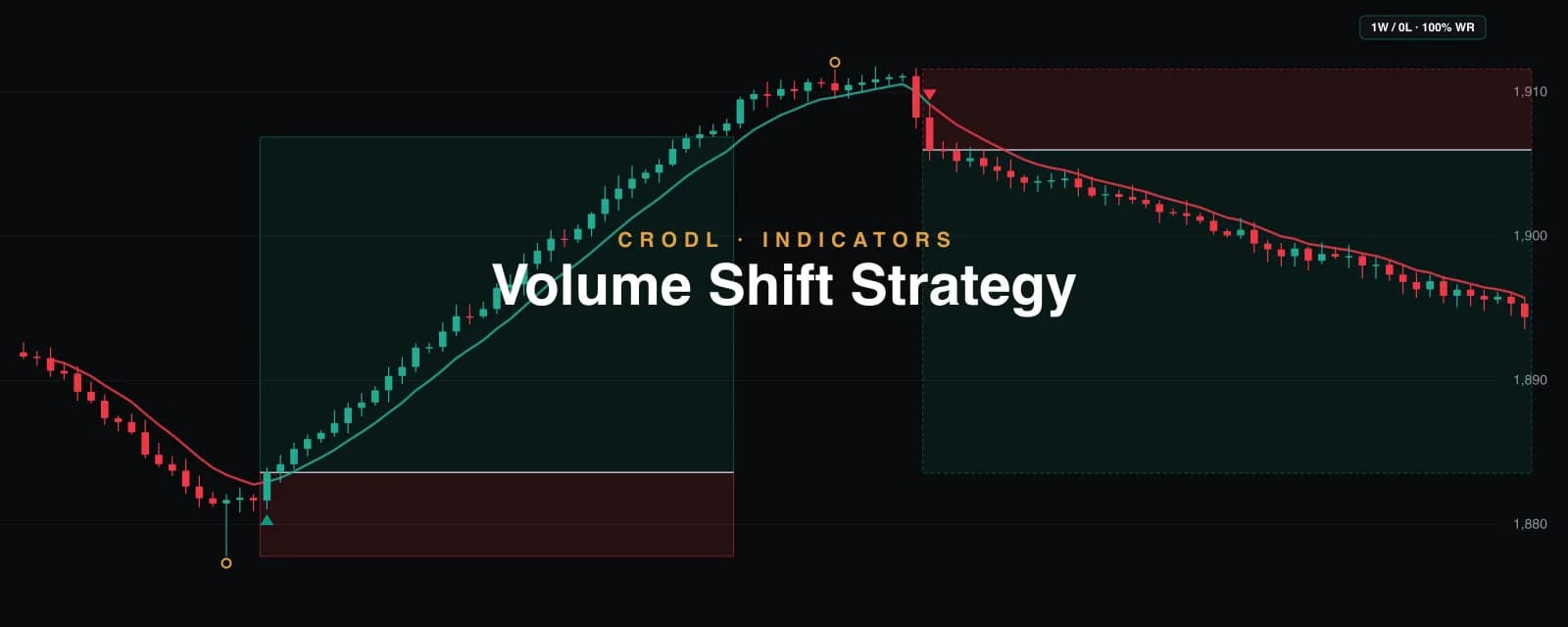
Volume Shift Strategy: The Trend Flips, Traded at 1:4
How Crodl's Volume Shift Strategy trades trend flips mechanically: entry at the flip close, stop at the previous swing, 4R target, plus daily discipline stops.
Volume Shift answers when the regime turns: an EMA basis with an ATR deadband, where the trend only shifts once price closes beyond the opposite band — hysteresis that ignores chop and guarantees the flips strictly alternate, bull, bear, bull. Volume Shift Strategy answers what trading every flip would have done, and draws it: entry, stop, target, outcome, and the running score.
The rules (all of them)
- Entry — the flip candle's close. A bull shift buys, a bear shift sells; alternation is built into the state machine, so there is never a second same-side entry to argue about.
- Stop — the previous swing low (longs) or swing high (shorts): the most recent confirmed symmetric swing on the protecting side of the entry, with an optional ATR buffer beyond it (default 0 — the swing is the stop). A flip that fires before any swing has confirmed falls back to the producing candle's own low/high.
- Target —
Reward : risk× the risk, default 4. Entry 100, swing stop 98 → target 108. The geometry is drawn as the position-tool picture: red risk zone to the stop, green reward zone to the target. - One trade at a time — a flip during an open trade is skipped, and outcomes walk forward conservatively: a bar that touches both stop and target counts as the stop.
- The scoreboard — the W/L hit-rate pill top right. A strategy without its score is a mood board.
The discipline stops
The Risk group carries three daily circuit-breakers, all evaluated on the UTC day a trade resolves in:
- Stop for the day once up — once the day's realized R is positive, no new entries until tomorrow.
- Stop after N losses — the classic tilt guard (0 = off).
- Stop after N wins — new with this strategy: bank the day after N winners and walk away (0 = off). Set it to 1 and the strategy takes exactly one winner per day, then goes quiet.
Skipped means skipped — the gates only block new entries; an open trade always finishes its walk.
Why the swing stop
A trend flip says the regime changed; the previous swing is where that claim dies. A long entered on a bull shift is wrong if price trades back below the last higher low — so that's where the stop goes, not at an arbitrary ATR distance. It also sizes the bracket to structure: wide after a deep pullback, tight after a shallow one, and the 4R target scales with it.
Honest limitations
This is a trend system bracketed like a sniper: with the stock EMA-100 deadband, flips are rare (a handful per thousand bars on 5-minute crypto tape), and a 4R target asks a lot of each one — in ranging tape the hit rate will look ugly while one clean trend pays for the losers. Shorten the EMA or the deadband to trade more often, drop the reward:risk to resolve faster, and read the pill over a real sample before judging. The half-way pullback entry from the sibling strategies is here too — same never-chase rules, same trade list.
Frequently Asked Questions
Does it repaint?
No. The signal engine is a bar-for-bar port of the Volume Shift preset (oracle-tested against the actual Rune runtime), it computes on closed candles only, and resolved trades never change. The only thing that develops is the open trade's zone extending to the newest bar.
Why did a flip not become a trade?
Three reasons, in order of likelihood: a trade was still open (one at a time), a daily stop had tripped (up on the day / N losses / N wins), or the stop geometry was invalid on that bar.
How is this different from Risk Pilot Strategy?
Risk Pilot Strategy trades UT-Bot trail crosses with the stop beyond the producing candle; Volume Shift Strategy trades deadband regime flips with the stop at market structure. Same trade engine, same scoreboard — different signal, different stop philosophy. Run both and let the pill decide.
Which settings matter most?
The EMA length and deadband width set how often you trade; the swing length sets how much room the stop gives. The defaults mirror the Volume Shift indicator exactly, so the strategy trades precisely the flips you already see on your chart.
Trade the shift
Volume Shift Strategy is live in the indicator picker on every Crodl terminal chart. Put it next to Volume Shift, set your daily stops, and let the scoreboard tell you whether your market pays the flip.
This article is for educational purposes only and is not financial advice. Leveraged trading carries substantial risk of loss. Always do your own research and never risk more than you can afford to lose.

Ready to automate your trading?
Connect your exchange, set up automations, and start trading smarter — all from one platform.
Start Trading Free