Pitchforks on Crodl: Andrews', Schiff and Modified Schiff
Three-click pitchfork tools on the Crodl chart: how the median line and tines are built, exactly how each variant shifts the origin, and when to use Schiff.
Most channel tools ask you where the boundaries are. A pitchfork asks something better: where is the centre? Pick three pivots — an origin and the swing that followed it — and the tool derives a median line that price keeps being pulled back toward, plus two parallel tines marking how far it strays before returning. Alan Andrews built the idea on the claim that price returns to that median most of the time. Whether or not you buy the number, the geometry gives you a moving equilibrium instead of a static level.
Crodl ships three — Andrews' Pitchfork, Schiff Pitchfork and Modified Schiff Pitchfork — in the "Channels & pitchfork tools" flyout on the drawing toolbar down the left edge of the chart, under a PITCHFORKS heading. All three are three-click tools, and the only thing separating them is where the median begins.
What the tool draws
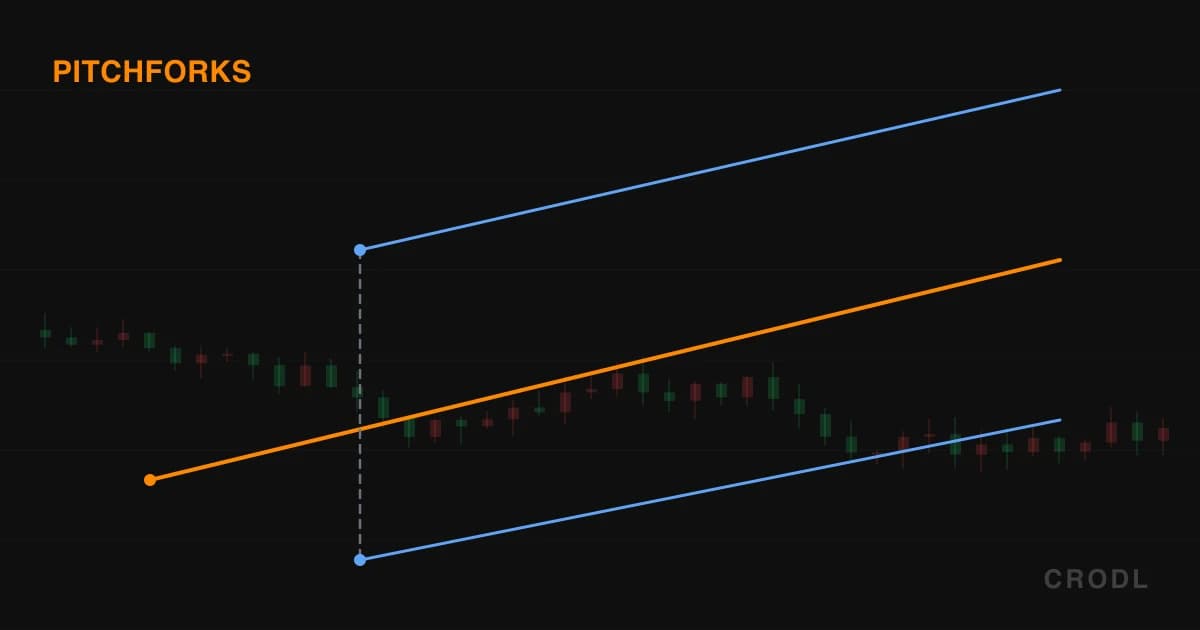
Three clicks, three anchors: P1 is the origin pivot, P2 and P3 the two pivots of the swing that followed it. On the third click the fork resolves into three lines.
The median line runs from the origin through the midpoint of P2–P3 and extends to the right edge of the plot area. The two tines are the lines through P2 and P3, each parallel to the median — they share its exact direction vector — and each also extends to the right edge. Nothing extends to the left of your anchors, and there is no fill: three strokes, that is the whole drawing. The median is drawn at full opacity and the tines slightly faded, so the equilibrium line reads first.
Handles sit on the three anchors you placed, and only those. Drag one and the fork recomputes; drag the body — median or either tine is grabbable — to shift all three anchors together without reshaping it. Before the third click the tool previews as a plain trendline from P1 to your cursor.
The three variants
Andrews' Pitchfork
The median starts at P1 itself and runs through the midpoint of P2–P3. This is the original construction and the honest one: nothing is adjusted, so the slope comes entirely from the three pivots you chose. When P1 is a clean pivot at a sensible distance from the P2–P3 swing, this is the fork you want.
Schiff Pitchfork
The median origin keeps P1's time but moves its price halfway toward P2 — the vertical midpoint of P1 and P2, on the same bar as P1. That single shift flattens the fork's slope without moving it forward in time.
The reason it exists: when the first leg from P1 to P2 is unusually steep — a capitulation wick, a liquidation candle, a listing spike — an Andrews fork inherits that steepness and projects a channel far too aggressive to hold. Halving the origin's distance to P2 says, mechanically, "the true origin was inside that move, not at its tip."
Modified Schiff Pitchfork
The median origin is the full midpoint of P1 and P2 — both time and price averaged — so it moves across as well as down, and the median starts later and flatter than a Schiff fork on the same points.
Reach for it when the first leg is steep and long. Schiff corrects the price extreme; Modified Schiff also concedes that the move took real time. On a wide first leg the gap between the two is substantial; on a short one it is barely visible.
In both variants the derived origin is purely visual: it never becomes a handle and is never stored, but is recomputed from P1 and P2 each time you drag.
How traders use it
The median as equilibrium
The median is the point of the whole tool: the fork's estimate of fair value through the developing swing. Above it, price is rich to the structure; below it, cheap. Pullbacks into the median are the natural continuation entries, and a market that keeps returning to it confirms the fork describes it. A sustained close through the median the other way is the first evidence the structure is finished.
The tines as reaction zones
The outer tines are boundaries, not targets. Touches of the upper tine in an uptrend are where legs exhaust and partials get taken; the lower tine is as far as the pullback usually goes. A tine that gets accepted — price closes outside and holds — means the trend has accelerated past the geometry and it is time to redraw from newer pivots.
Picking the variant
Draw the Andrews fork first. If its median sits well above or below where price actually traded — the classic symptom of a violent first leg — switch to Schiff on the same three pivots and compare. If that leg was long as well as steep, try Modified Schiff too. The right fork is the one whose median has price oscillating around it rather than living on one side of it.
Pitchforks pair naturally with pivot work: Pivot Levels and Swing Highs & Lows mark the turns most traders want as P1/P2/P3, and an Anchored VWAP dropped at P1 gives a volume-weighted second opinion on the same origin.
Styling and settings
There are none specific to pitchforks, deliberately. Select a fork and the drawing style bar offers the same controls as any line drawing: colour, line style (solid, dashed, dotted) and width, defaulting to 1.4px solid orange. No median multiplier, no extra parallels, no fill, and no keyboard shortcut — you pick the tools from the toolbar flyout, though Andrews also appears in the right-click Drawing tools menu. Forks save and restore with your other drawings, anchored to the candles you clicked.
Honest limitations
A pitchfork is a subjective tool wearing a mathematical costume. The geometry is exact, but the part that matters — which three pivots — is your call, and two traders drawing the same chart will routinely produce forks with materially different medians. Nudge P1 by a few bars and the whole projection rotates. It is very easy to pick the anchors that produce the fork you already wanted to see, and three origin rules make that easier, not harder: if one variant does not fit, another might. Decide what you are drawing before you draw it.
Two mechanical notes. Midpoints are computed in screen space, so on a logarithmic scale a Schiff origin is the visual halfway point between P1 and P2, not the arithmetic price midpoint; switch scales and the fork shifts slightly. And a fork is a projection, not a signal — it has no opinion about whether the structure still holds. When price repeatedly closes beyond a tine, the fork is stale.
Frequently Asked Questions
Which pivots should P1, P2 and P3 be?
A significant pivot as P1 plus the two pivots of the swing that followed: in an uptrend, P1 is a major low, P2 the high after it, P3 the higher low after that. Minor or unformed pivots are the most common reason a fork looks wrong.
What is the actual difference between Schiff and Modified Schiff?
Schiff moves the origin vertically only — same bar as P1, price halfway to P2. Modified Schiff averages both bar and price, so the origin also moves forward in time. Modified Schiff is therefore the flatter, later-starting of the two, and the gap between them grows with the width of the P1–P2 leg.
Can I add more parallel lines or Fibonacci levels inside the fork?
No — each fork is exactly one median plus two tines. For extra parallels around a trend, the parallel and regression channel tools sit in the same flyout and layer happily over a pitchfork on the same pivots.
Does the fork keep updating as new candles print?
The lines re-project to the right edge of the plot on every frame, so they extend forward automatically as new bars arrive. The geometry never changes on its own — only moving a handle changes the fork.
Draw the centre, not the edges
The three pitchforks are live in the Channels & pitchfork flyout on every Crodl terminal chart. Find the pivot that started a move, click the two that followed it, and you have a median to trade around — and if that first leg was too steep to trust, the Schiff variants are one click away on the same three points.
This article is for educational purposes only and is not financial advice. Leveraged trading carries substantial risk of loss. Always do your own research and never risk more than you can afford to lose.

Ready to automate your trading?
Connect your exchange, set up automations, and start trading smarter — all from one platform.
Start Trading Free