
CW Trend
CW Trend smooths all four Heikin Ashi series with a selectable moving average and paints the smoothed body as a directional cloud. How Crodl's house trend tool works.
Heikin Ashi candles are the most popular trend-reading trick in crypto for a simple reason: by averaging each candle against the last, they turn choppy price action into legible runs of green and red. But raw Heikin Ashi still flickers — one strong counter-candle can break a run — and reading trend from candle colors alone leaves you squinting at the chart asking how much conviction is behind the color.
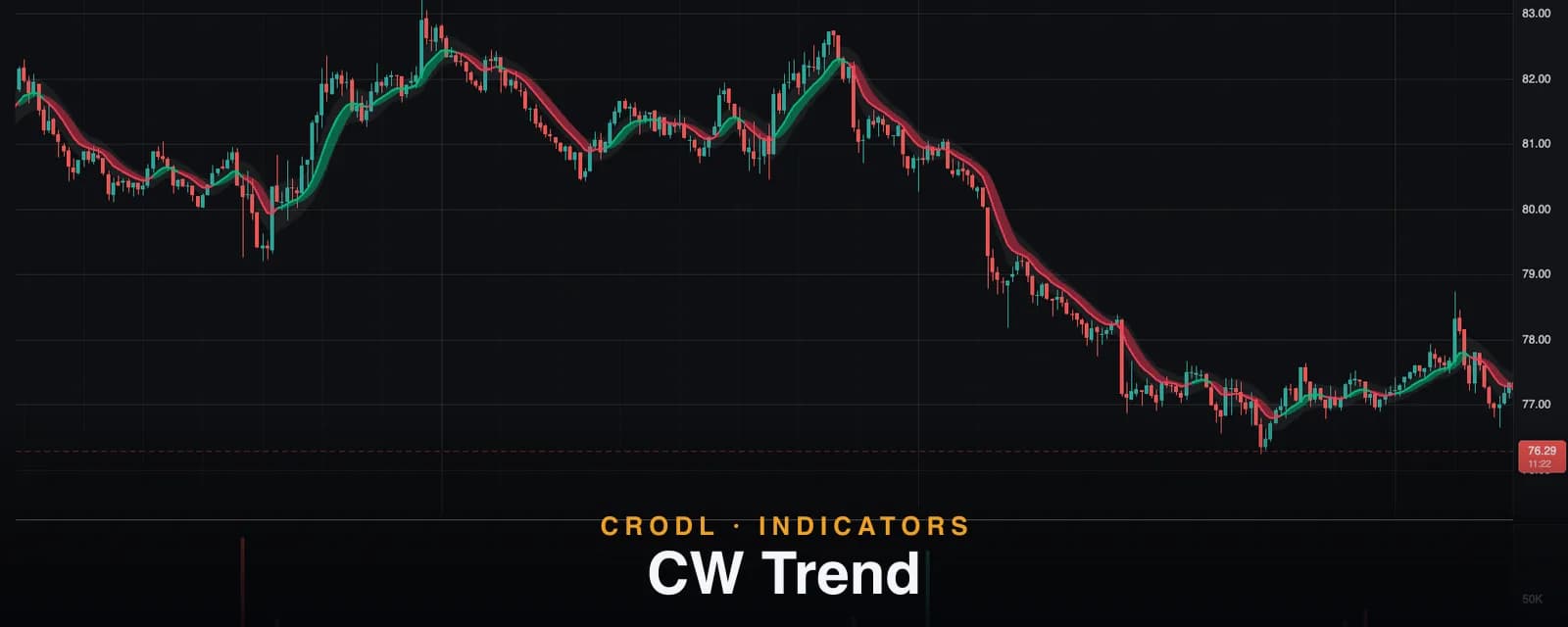
CW Trend, Crodl's house trend indicator, takes the Heikin Ashi idea one step further: it computes the Heikin Ashi open, close, high, and low, then smooths all four series with a moving average of your choice, and draws the result as a single directional ribbon — a smoothed HA body painted green or red, wrapped in faint clouds that mark the smoothed wick range. The double transformation (HA first, then MA) produces one of the cleanest trend reads on the terminal: candle noise is absorbed by the Heikin Ashi step, and the residual flicker is absorbed by the smoothing step.
The result reads less like an indicator and more like a weather system behind your candles — and because it ships as a Rune preset, every line of it is inspectable and editable on the chart.
What CW Trend shows
- The close line — the smoothed Heikin Ashi close, drawn green while the trend reads up and red while it reads down. This is the signal line most traders watch.
- The body cloud — a translucent fill between the smoothed HA open and smoothed HA close, in the trend color. Its thickness is the size of the smoothed HA body: thick cloud, strong directional drive; thin cloud, fading conviction.
- Wick clouds — faint gray fills from the body out to the smoothed HA high and low, sketching the full smoothed range around the body.
- Optional high/low lines — gray outlines of the smoothed HA high and low, off by default (Show High/Low lines).
How it works on the Crodl terminal
Add CW Trend from the indicator picker and the Rune script runs on the chart directly. The pipeline has three stages.
Stage one: Heikin Ashi. The indicator derives the four Heikin Ashi series from your chart's real OHLC data. Your candles stay whatever type you prefer — CW Trend does the HA transformation internally, so you get the smoothing benefit without giving up real prices on the chart itself.
Stage two: smooth everything. Each of the four HA series is passed through the selected moving average — MA Type (default EMA) at MA Period 9 (range 1–200). Eight MA types are available, and swapping them changes the indicator's personality more than any other setting:
| MA type | Character |
|---|---|
| EMA (default) | Balanced — responsive with acceptable lag |
| SMA | Slowest, steadiest; fewest color flips |
| WMA | Linearly front-weighted; quicker than SMA |
| HMA | Fastest to turn; can overshoot in chop |
| ZLEMA | Lag-compensated EMA; early but twitchier |
| VWMA | Volume-weighted; leans toward high-participation bars |
| SWMA | Fixed symmetric 4-bar weighting; period-independent |
| ALMA | Gaussian-weighted; tuned via ALMA Shift (0.85) and Deviation (6) |
Stage three: score the direction. Each bar, CW Trend computes a trend score: the smoothed HA body as a percentage of the smoothed HA range —
trend = 100 × (smoothed HA close − smoothed HA open) / |smoothed HA high − smoothed HA low|
The score lives between −100 and +100. The direction is simply its sign: up when the smoothed HA close is above the smoothed HA open, down otherwise (a zero body counts as down). The close line and body cloud take their color from that sign, and the flip bar is drawn so the outgoing and incoming colors share a seam — no gaps at transitions.
Because the flip condition is smoothed body direction — not price crossing a line — CW Trend ignores individual candles entirely. A single violent red candle inside an uptrend barely dents the smoothed HA body; it takes a genuine shift in the balance of candles to swing the score through zero.
For traders who want to backtest the same engine, the terminal also ships CW Trend Strategy — an identical pipeline in strategy mode that enters long on the up-flip, short on the down-flip (auto-reversing), and trails an ATR(14) stop at a configurable multiple (Stop Mult, default 5).
How traders use it
As the directional backdrop
The most common setup: CW Trend on the chart, entries from something faster. Longs only while the ribbon is green, shorts only while red. Its flips are lazy by design — with the default EMA-9-on-HA it changes color far less often than a 9 EMA cross ever would, because the HA step has already absorbed most of the noise. Traders wanting a second opinion pair it with Supertrend, which defines trend by ATR distance rather than candle balance — agreement between the two is a strong filter.
Reading cloud thickness
The body cloud is a built-in conviction gauge. An expanding cloud means each smoothed candle is closing further from its open — acceleration. A narrowing cloud during a trend is the earliest visible warning that drive is fading, often several bars before any color flip. Watching thickness rather than waiting for flips is how experienced users squeeze the most out of this tool.
Trading the color flip
The flip itself — smoothed HA body crossing zero — is a legitimate momentum signal on higher timeframes, particularly when a regime filter agrees. A common Crodl stack is CW Trend for the trigger with the Deadband channel as the consensus veto behind it: take the flip only when the channel color matches.
Picking the MA type
Scalpers reach for HMA or ZLEMA and accept extra flips; swing traders stay with the default EMA or step up the period; position traders run SMA or ALMA on 4h/daily where a single flip can define a month. If you are unsure how the underlying averages differ, our EMA guide covers the trade-offs.
Frequently Asked Questions
Why Heikin Ashi instead of smoothing real candles?
Heikin Ashi is itself a smoothing pass — each HA candle averages the current bar against the previous HA candle — so CW Trend is effectively a double filter. Smoothing raw OHLC with a 9-period MA alone would leave far more flicker in the body direction than smoothing HA series does.
Isn't a 9-period average too fast for a trend tool?
It would be on raw candles. On Heikin Ashi series the recursion carries memory of prior bars, so EMA-9-on-HA behaves much slower than EMA-9-on-price. Raise the period if you want a glacial regime read; the range goes to 200.
Does CW Trend repaint?
Closed bars never change. The forming bar's HA values update with live price, so the current bar's color can shift until it closes — standard behavior for any HA-based tool.
Can I backtest it?
Yes — add CW Trend Strategy from the same preset list. It trades the exact flip conditions described above with an ATR-based stop, and runs in the terminal's built-in backtester with configurable commission and sizing.
Put a weather system behind your candles
CW Trend is available on every Crodl terminal chart — add it from the indicator picker, pick your MA flavor, and the ribbon is live in one click, alongside trading on six exchanges.
This article is for educational purposes only and is not financial advice. Leveraged trading carries substantial risk of loss. Always do your own research and never risk more than you can afford to lose.

Ready to automate your trading?
Connect your exchange, set up automations, and start trading smarter — all from one platform.
Start Trading Free