
Volume Spikes: Highlight the Candle When Volume Erupts
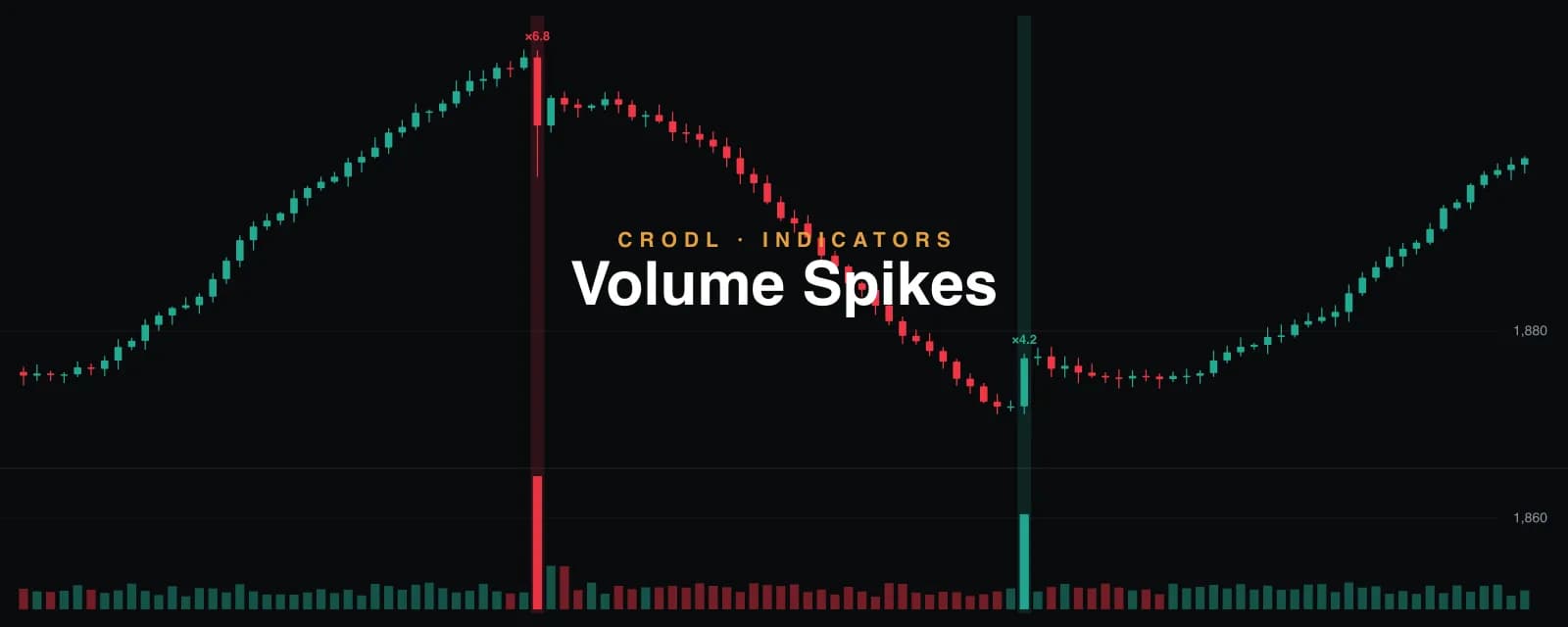
How Crodl's Volume Spikes indicator flags every candle whose volume towers over the recent bars — a translucent column, border, or body highlight with the ×-multiple, straight on the price chart.
Everyone reads the volume pane the same way: scan for the bar that towers over its neighbours, then look up to see which candle did it. Volume Spikes removes the round trip — whenever a candle's volume erupts past the recent bars, the candle itself gets highlighted, so the event is visible where you're actually looking: on price.
How it decides
A closed candle is a spike when its volume is at least threshold% (default 50%) bigger than its base, and the base always uses strictly prior bars — the spike never inflates its own yardstick. Three base modes:
- Highest of prior bars (default) — the volume must beat everything in the last
lookbackbars (default 10) by the threshold. On live crypto tape this flags roughly 4% of candles — the true "towers over its neighbours" events, like the one that made you install this. - Average of prior bars — denser and regime-relative (~18% of bars at the same threshold); useful when you want every above-normal print, not just the eruptions.
- Previous bar — the literal "50% bigger than the last candle" read; densest and noisiest.
How it looks
- Column (default) — a translucent full-height band behind the candle, tinted by the candle's direction (teal up / rose down), slightly stronger the further the spike exceeded the threshold.
- Candle border or body repaint — for a quieter chart, only the candle itself is marked.
- Optional ×-multiple label (off by default): "×4.2" above the bar tells you exactly how big the print was.
Closed candles only — a forming bar's volume is still accumulating, so judging it mid-bar would flicker; nothing repaints.
How traders use it
- Validation — a level break on a spike is a different animal from one on air. Pair with Pivot Levels or a Profile Shapes box edge: the spike is the conviction reading on the trigger bar.
- Exhaustion — a huge spike on a long-wick candle into an extreme is the classic capitulation/stop-run print — the exact event the Cascade family trades, seen through the volume lens.
- Attention routing — on a multi-chart layout, the columns make "something happened here" visible from across the room. That's the whole job.
Volume Spikes vs Volume Bubbles
Same family, different statistics: Volume Bubbles sizes a bubble by z-score against a long rolling baseline (how unusual is this vs the last 60 bars, in standard deviations); Volume Spikes is the simple ratio read against the immediate neighbourhood (is this X% bigger than the recent bars). Bubbles rank; Spikes flag. Run whichever matches how you think — or both.
Honest limitations
Volume says that participation surged, not who won — a spike marks the event, and the candle's close tells the outcome. Ratio thresholds are venue-relative: 50% over the recent max is meaningful on a liquid pair and routine on an illiquid one, which is why the threshold, window, and mode are all exposed. And after a dead-quiet stretch, the first normal-volume bar can legitimately register as a spike in average mode — volume waking up is an event, but know that's what you're seeing.
Frequently Asked Questions
Does it repaint?
No. Only closed candles are judged, against bases built from strictly earlier closed candles. A highlight never appears early, moves, or vanishes.
Why didn't an obviously big bar get highlighted?
Check the mode: in the default highest-of-prior mode, a big bar right after an even bigger one won't fire — it didn't beat the recent maximum by the threshold. Switch to average mode if you want those too.
What threshold should I use?
The default (50% over the recent max) matches the eyeball read. Raise it to 100%+ to keep only the eruptions; drop the mode to average at 100–200% for a balanced middle ground.
Stop scanning the volume pane
Volume Spikes is live in the indicator picker on every Crodl terminal chart. Turn it on, and the candles that matter announce themselves.
This article is for educational purposes only and is not financial advice. Leveraged trading carries substantial risk of loss. Always do your own research and never risk more than you can afford to lose.

Ready to automate your trading?
Connect your exchange, set up automations, and start trading smarter — all from one platform.
Start Trading Free