
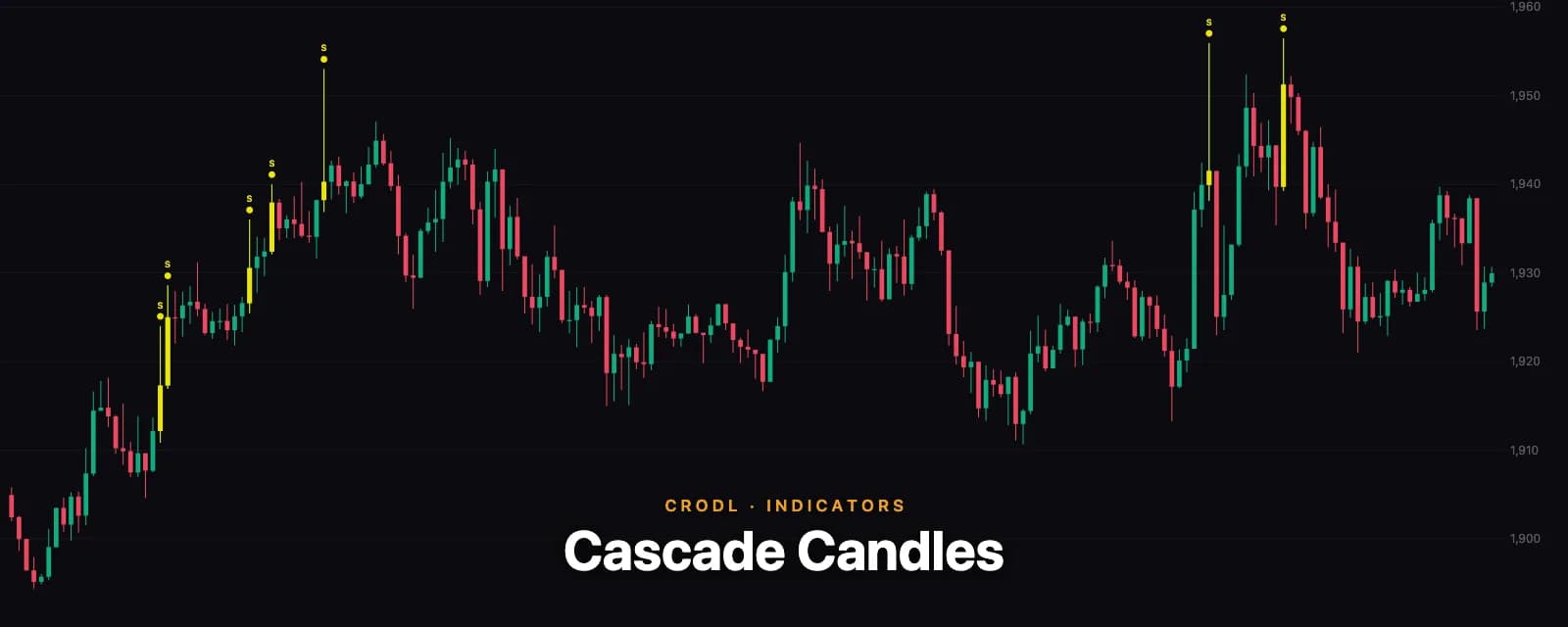
Cascade Candles: The Pure Stop-Cascade Detector
How Crodl's Cascade Candles study marks every closed candle that sweeps a prior extreme on outsized range and volume with a rejection proxy — no entries, no zones, just the cascade candles themselves.
The cascade family on the Crodl terminal now has three members, and this is the simplest: Cascade Candles detects the stop-cascade candle and does nothing else. No pending states, no entries, no stops, no zones — every closed candle that qualifies is painted yellow with a small L/S marker, and that's the whole indicator.
It exists because detection and trading are different jobs. Cascade Exhaustion and Cascade 3-Bar Play each bolt an entry discipline onto this same trigger — which necessarily hides candles (one pending setup at a time, cooldowns, cancellations). When you want the raw map — every stop run on the chart, nothing filtered by trade management — this is the tool.
What qualifies a candle
The exact stage-one gates shared across the family:
- Sweeps a prior extreme — beyond the highest high or lowest low of the last
Prior-extreme lookbackcompleted bars (default 20) by at leastMin sweep× ATR. - Outsized range — at least
Min candle range× ATR (default 1.25). - Elevated volume — at least
Min volume ratio× the prior 50-bar average (default 1.75×). - A cascade-matching body (toggleable), with double-sided sweeps discarded by default.
- The rejection proxy — wick rejection (default), reclaim close, or none (Cascade only).
The marker letter is the hypothesized fade side — L under a downside sweep, S above an upside sweep — as a reading aid, not a signal.
Two detector-specific differences from the trading variants: the cooldown defaults to 0, so consecutive qualifying candles all mark (the trading versions suppress signals while a setup is pending — this one never does), and retention is a generous 200 signals. All values are prior-bar references, scanned on closed candles only — no repaint.
How traders use it
- As the raw map — see every stop run at once and judge the regime: clusters of upside cascades into a level tell a different story than one clean sweep.
- As a discretionary trigger — take the yellow candle into your own execution rules, rather than the two shipped entry disciplines.
- For confluence — a cascade candle landing on a Liquidity Zones level, printing a Volume Bubble, or forming the sweep leg of a W or M pattern is the same event confirmed through independent lenses.
- For tuning — dial the thresholds here first, watching what qualifies, then carry the settings into Cascade Exhaustion or Cascade 3-Bar Play knowing exactly what the trigger admits.
Honest limitations
Same as the whole family: this is OHLCV inference, not order-flow observation — a candle can sweep a level on volume for reasons other than cascading stops, and no chart-data method can tell the difference. Confirmation-first means the candle marks at its close, after the move happened. What you do with the information is deliberately left to you.
Frequently Asked Questions
Does it repaint?
No. Each candle is judged on its own closed bar against prior-bar reference values; marks never move or vanish except by rotating out of the retention window.
Why does it show more candles than Cascade Exhaustion on the same settings?
Because nothing suppresses it: the trading variants hold one pending setup at a time and run a cooldown from each accepted setup, so cascades that fire during a pending window never appear there. This detector marks them all — with the cooldown at its default of 0.
Can I turn it into alerts or entries?
That's what the siblings are: Cascade Exhaustion adds the directional-close entry, Cascade 3-Bar Play the pattern-confirmed entry. Run this one alongside them to see what their trade logic filtered out.
The map before the trade
Cascade Candles is live in the indicator picker on every Crodl terminal chart. Put it on your pair, let the yellow marks accumulate, and read the story of who got stopped where — before you decide which of them to fade.
This article is for educational purposes only and is not financial advice. Leveraged trading carries substantial risk of loss. Always do your own research and never risk more than you can afford to lose.

Ready to automate your trading?
Connect your exchange, set up automations, and start trading smarter — all from one platform.
Start Trading Free