
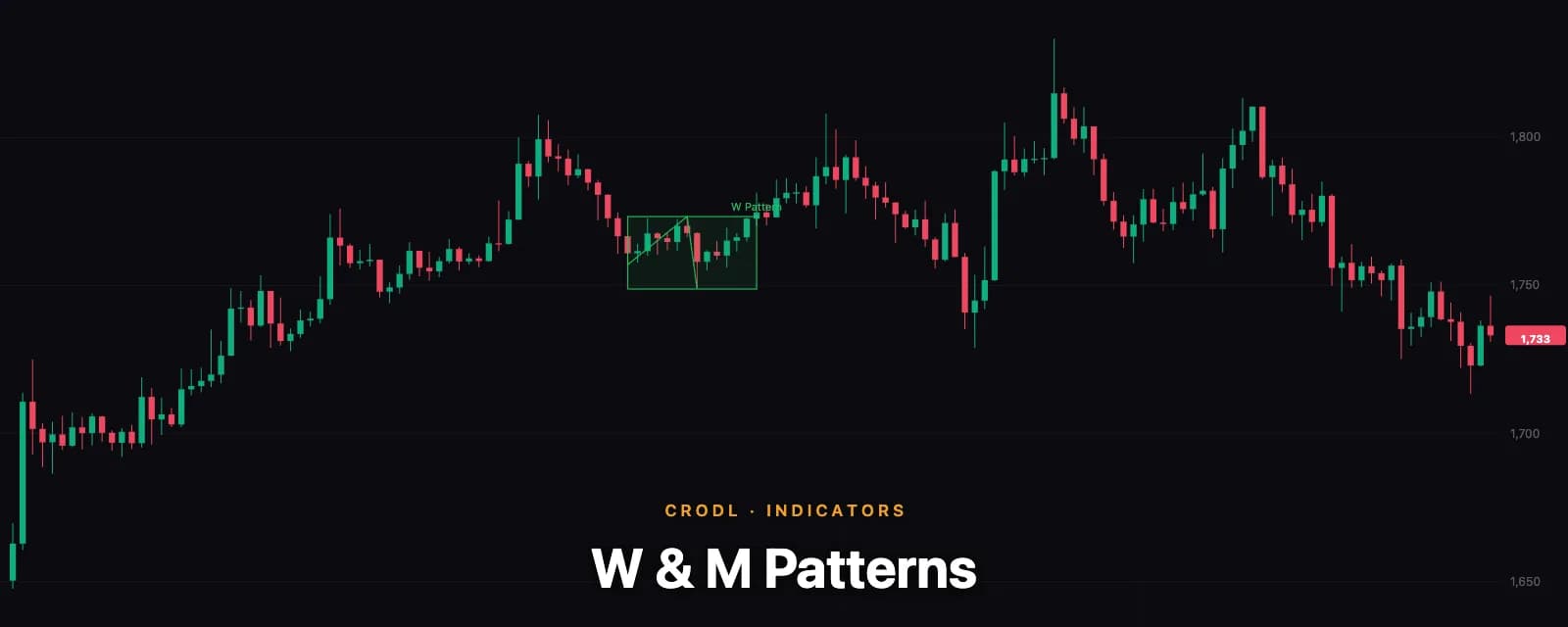
W & M Patterns: Automatic Sweep-Reversal Detection
How Crodl's W and M pattern detectors find the liquidity-sweep variant of double bottoms and tops — a wick through the first extreme that fails and reverses — and only draw them once the neckline break confirms.
Ask a textbook and a double bottom has two equal lows. Ask anyone who trades crypto and they'll tell you the second low usually isn't equal — it's lower. Price dips through the first low, runs the stops resting under it, and only then reverses. The result on the chart is a W whose second leg digs deeper than the first, or its mirror image: an M whose second peak pokes above the first before failing. Same reversal, different mechanics — and the sweep is the point, not a blemish.
The W Pattern and M Pattern detectors on the Crodl terminal find exactly this variant. They live in the same Chart Patterns family as the double tops and bottoms, and the two definitions partition cleanly: if the two extremes match within tolerance, it's a double; if the second extreme exceeds the first by more than the tolerance, it's a W or M. One structure can never fire both detectors.
What the detectors require
A W Pattern (bullish) is three swings — low, high, low — where:
- The sweep. The second low undercuts the first by more than the ATR-scaled match tolerance. This is precisely the structure the classic double bottom rejects, so the two detectors never overlap.
- The failure. The sweep candle must close back above the first low. A wick below with a close back inside is a failed breakdown — the stop run. A candle that closes below and holds there is a real breakdown, and the detector walks away.
- The confirmation. Within the family's lookahead window, a candle must close above the middle peak (the neckline). Until that close prints, nothing is drawn. If price instead closes below the sweep low first, the pattern is invalidated and never appears.
The M Pattern (bearish) is the exact mirror: a higher-high sweep above the first peak, a close back below it, and a confirming close through the middle valley.
Both inherit the family's structural quality gates unchanged: the pattern's height must clear twice the noise tolerance, a genuine prior trend must precede it (a W reverses a decline, an M reverses an advance), and price must stay contained inside the pattern's band between the first and last swing. And like every detector in the family, they scan closed candles only and draw only after confirmation — no forming-pattern hopium, no repaint.
W/M versus double bottom/top
| Double Bottom / Top | W / M Pattern | |
|---|---|---|
| Second extreme | Equal within tolerance | Beyond the first by more than tolerance |
| The extra leg | — | Must close back inside (wick-only failure) |
| Market read | Level held twice | Level was swept, trapped traders fuel the reversal |
| Overlap | Never fires as W/M | Never fires as double |
The distinction matters because the sweep variant carries its own logic: the stops below the first low (or above the first high) get consumed, the aggressive breakout traders are trapped on the wrong side, and the reversal that follows has fuel the polite equal-low version doesn't. It's the same structure ICT traders call a liquidity grab into a swing-failure, drawn mechanically instead of by eye.
How traders use it
The retest entry
Every drawn W already broke its neckline, so the classic play is the same as for the family's other reversals: wait for the retest of the broken neckline and join in the breakout direction if it holds. Pairing with Breakout Retest puts the level-flip logic on the chart next to the pattern that caused it.
Sweep-level confluence
The sweep low of a confirmed W is a proven demand point — price went below the obvious level, found buyers, and left. Those extremes frequently line up with Liquidity Zones sweeps and Visible S/R flips; when the W's sweep low and a liquidity sweep marker agree, you're looking at the same event through two lenses.
The measured move
The pattern box spans the full height including the sweep — neckline to sweep extreme. The conventional target projects that height from the breakout point, and because the sweep deepens the box, W/M targets are naturally more ambitious than their double-pattern cousins.
Settings
W and M share the Chart Patterns family settings: Swing length (pivot granularity, default 3), Tolerance (× ATR14) (what counts as "equal" vs "beyond", default 0.35), Max patterns drawn, labels, and colors. Run them from the All Chart Patterns study alongside the doubles, triples, rectangles, and flags — or add W Pattern / M Pattern individually from the picker's Patterns tab.
Honest limitations
The confirmation-first design means you see the pattern only after the neckline breaks — this is a context and confirmation tool, not a prediction of the sweep as it happens. The wick-only-failure rule is strict by design: a sweep candle that closes beyond the first extreme disqualifies the pattern even if the next candle reclaims, which occasionally filters out a reversal a human would have counted. And the sweep must exceed the ATR tolerance — a one-tick undercut still reads as a double bottom, which is usually the right call.
Frequently Asked Questions
How is this different from the double bottom I already run?
Mechanically: the double bottom demands equal lows within tolerance; the W demands the second low beyond tolerance plus a close back inside. Conceptually: one is a level holding twice, the other is a level being swept and failing. The detectors are mutually exclusive, so running both costs nothing and covers both behaviors.
Does it repaint?
No. Detection runs on closed candles only, the sweep-failure test uses the sweep candle's own final close, and the pattern is recorded at its confirming breakout bar. Drawn patterns never move or vanish except by rotating out of the max-patterns window.
Why didn't it mark an obvious W I can see?
Usually one of three gates: the second low didn't undercut by more than the tolerance (that's a double bottom — check that detector), the sweep candle closed below the first low instead of wicking, or the neckline break never printed inside the lookahead window. The gates are the feature: what survives them broke out for real.
Can I run only the M patterns?
Yes — add M Pattern as its own study from the picker, or set the family study's Pattern selector to it. Bearish-only scanning for shorts at highs is a common setup.
Trade the trap, not the hope
The W & M detectors are live in the indicator picker on every Crodl terminal chart, inside the Chart Patterns family. Turn them on and the next stop-run that reverses will draw itself — swept low, failed break, confirmed neckline — while it's still tradeable.
This article is for educational purposes only and is not financial advice. Leveraged trading carries substantial risk of loss. Always do your own research and never risk more than you can afford to lose.

Ready to automate your trading?
Connect your exchange, set up automations, and start trading smarter — all from one platform.
Start Trading Free